How Does a Nurse Call System Work? A Complete Guide

A nurse call system allows patients or residents to request assistance by pressing a bedside call button, pulling a bathroom cord or activating a wearable call device. The system sends the call to a nurse station display, corridor light, pager, watch or monitoring device, showing caregivers where the call originated. A staff member can then respond, reset the call and, where supported, review the event in the system’s call history.
Although these systems are often called nurse call systems, nurse call bell systems, patient call systems or nursing call light systems, they all serve the same basic purpose: connecting patients with caregivers quickly and clearly.
What Is a Nurse Call System?
A nurse call system is a communication and alert system used in hospitals, nursing homes, assisted living facilities, clinics and other healthcare environments. It gives patients and residents a simple way to notify staff when they need assistance.
A basic system usually includes a nurse call button and a receiver. More complete systems may also include bedside call stations, bathroom pull cords, corridor lights, nurse station displays, pagers, nurse call watches, signal repeaters and management software.
The system can be wired or wireless. A wired nurse call system transmits calls through physical cabling, while a wireless system uses radio signals to connect call devices with receivers. The most suitable option depends on the building, required functions, installation conditions and project budget.
How Does a Nurse Call System Work?
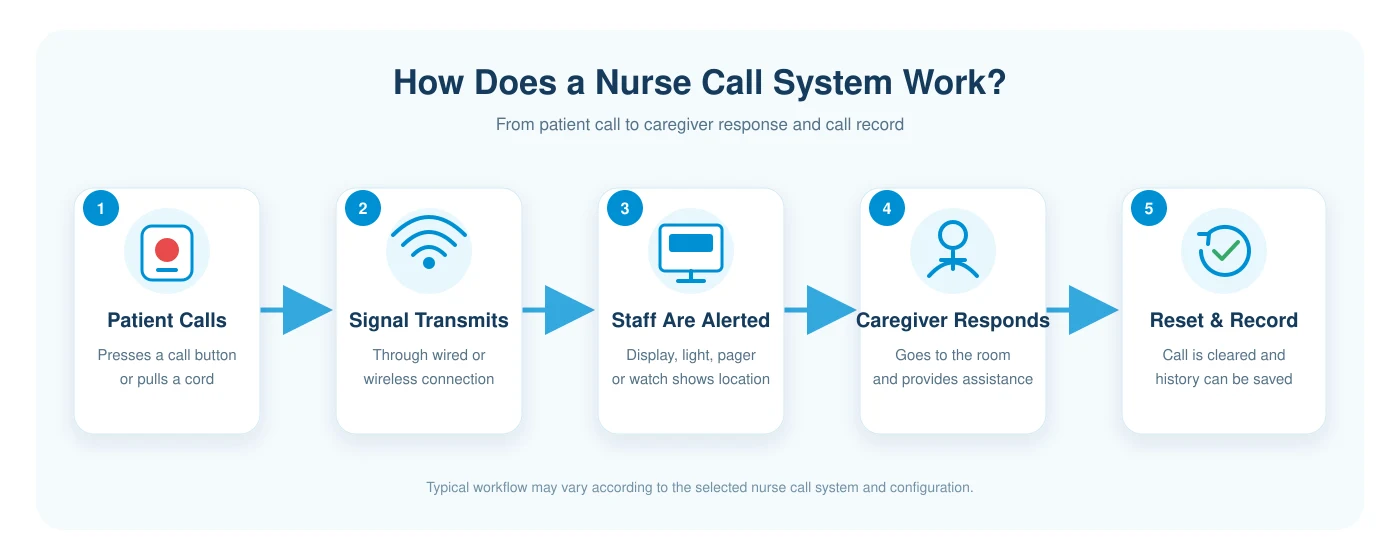
A typical nurse call workflow from patient call initiation to caregiver response and call reset.
A nurse call system normally follows five steps, from the patient initiating the call to a caregiver responding and resetting it.
[Insert the “How Does a Nurse Call System Work?” workflow image here]
Step 1: The Patient Activates a Call Button
When a patient needs help, they press a nurse call button near the bed, use a handset call unit or pull an emergency cord in the bathroom.
In a nursing home, a resident may also carry a wearable call button or pendant. This allows the resident to request assistance when moving around a room or common area instead of relying only on a fixed bedside button.
Different buttons can be assigned to different locations or call types. For example, a display may show “Room 108 Bed 2,” “Bathroom 205” or another programmed message so staff can immediately identify where assistance is required.
Step 2: The System Transmits the Call Signal
After the patient presses the button, the system sends the call to one or more receiving devices.
In a wired nurse call system, the signal travels through cables between the bedside or bathroom call station and the main console. Wired systems provide a fixed connection and may support functions such as two-way voice communication, depending on the system configuration.
In a wireless nurse call system, the call is transmitted using radio communication. No communication cable is required between the wireless call button and the receiver, making wireless systems particularly useful for retrofit projects and buildings where new cabling would be difficult or expensive.
Wireless coverage depends on the radio technology, building layout, walls, floors and local interference. Repeaters or signal bridges can be added when a project covers multiple floors or a large area.
Step 3: Nurses Receive the Alert
The transmitted signal activates one or more receiving devices. Depending on the system design, staff may receive the call through:
-
A nurse station display or main console
-
A corridor call light outside the room
-
A portable pager
-
A wearable nurse call watch
-
A tablet monitor
-
Computer-based management software
The receiver normally displays the programmed call location. Some systems can also show the call type, call time or current status.
A corridor light provides a clear visual indication outside the patient’s room. Meanwhile, a pager or watch allows mobile caregivers to receive alerts when they are away from the nurse station. Using several receiving methods together can help reduce the risk of a call being overlooked.
Step 4: A Caregiver Responds to the Patient
After receiving the alert, a nurse or caregiver goes to the displayed room or location and provides the required assistance.
The request may involve routine support, such as help getting out of bed, or a more urgent situation, such as a bathroom fall or medical emergency. Because the system identifies the call location, staff do not need to search for the person requesting help.
In systems with two-way voice communication, nursing staff may be able to speak with the patient before arriving. However, this function is not included in every nurse call system. Many wireless systems are designed primarily for sending location-based alerts rather than voice communication.
Step 5: The Call Is Reset and Recorded
Once a caregiver arrives, the call can be reset using a cancel button, reset button or bedside call station. Resetting the call removes it from the receiver and turns off the related corridor light or audible alert.
Systems equipped with management software may also store call records. Depending on the model and configuration, the records can include the call location, call time, call type and reset time. Healthcare managers can use this information to review activity and identify response patterns.
Main Components of a Nurse Call System
The exact components vary by project, but most nurse call bell systems use several of the following devices.
Nurse Call Button
The nurse call button is the main device used by a patient or resident to request assistance. It may be mounted beside a bed, placed on a table, connected to a handset or worn as a pendant.
Buttons should be easy to recognize and operate, especially for older people or patients with limited mobility.
Bathroom Pull Cord
A bathroom pull cord allows a patient to initiate an emergency call from a toilet or shower area. Pull cords are normally installed where they can be reached from both standing and floor level.
Nurse Station Display or Main Console
The display receiver or main console shows where a call originated. It is usually placed at a nurse station, reception desk or another staffed location.
A wired main console may also support two-way communication with compatible patient substations. Wireless displays generally focus on receiving and showing programmed call information.
Corridor Call Light
A nurse call light is installed outside a patient room or above a doorway. When a patient activates a call, the light gives staff a visual indication of the room requiring attention.
Some corridor lights can use different colors or flashing patterns to represent different call types, depending on the selected products and system configuration.
Pager or Nurse Call Watch
Portable pagers and watches allow caregivers to receive calls while moving around the facility. The screen can display the room number, bed number or programmed location, helping staff respond without returning to the nurse station first.
Repeater or Signal Bridge
A repeater receives and retransmits wireless signals to extend coverage. It can be useful in large buildings, multi-floor facilities or locations with thick walls and other structural obstacles.
Management Software
Compatible management software can provide call monitoring, history records and data export. More advanced configurations may support tablet monitoring, floor plans, staff duty information or other management functions.
Wired vs. Wireless Nurse Call Systems
Both technologies can provide effective patient-to-staff communication, but they suit different projects.
| Feature | Wired Nurse Call System | Wireless Nurse Call System |
|---|---|---|
| Signal transmission | Physical cabling | Radio communication |
| Installation | Requires cable routing | Minimal communication cabling |
| Best suited for | New construction and fixed installations | Retrofits, expansions and existing buildings |
| Voice communication | Available on compatible systems | Usually location-based alerts without voice |
| Expansion | May require additional cabling | Additional wireless devices can usually be registered |
| Receiving devices | Main console, substations and corridor lights | Displays, pagers, watches, corridor lights and software |
| Main consideration | Cabling design and installation work | Wireless coverage and signal testing |
Aidbell offers a wired nurse call system with two-way voice communication, as well as several wireless options for projects that prioritize flexible installation.
The 433 MHz wireless nurse call system is a cost-effective option for small and medium-sized facilities. The LoRa wireless nurse call system provides longer transmission range and calling success confirmation, while the POCSAG nurse call system supports long-range paging and mobile pager reception.
How Nurse Call Systems Work in Hospitals
A hospital nurse call system connects patient rooms, bathrooms and nursing staff through a combination of call buttons, patient substations, corridor lights, central consoles and portable receivers.
A patient may press the hospital call button beside the bed. The nurse call light outside the room activates, and the nurse station receives the room or bed information. Staff can then respond and reset the call after providing assistance.
Hospitals must consider the required functions carefully. Projects that require fixed room communication and two-way voice may prefer a wired system. Clinics, rehabilitation centers, temporary wards and retrofit projects may benefit from a wireless solution that requires less construction work.
Learn more about Aidbell hospital and healthcare calling solutions.
How Nurse Call Systems Work in Nursing Homes
A call bell system for nursing homes helps residents request assistance while supporting their independence.
Residents can use bedside call buttons, bathroom pull cords or wearable emergency buttons. Calls can be sent to a central display, corridor call light, pager or caregiver watch. Portable receivers are particularly useful because caregivers often move between resident rooms and common areas.
Wireless systems are commonly considered for existing nursing homes because devices can be installed without extensive communication cabling. Additional rooms, buttons or receivers can also be added as the facility expands, subject to system capacity and wireless coverage.
Explore nurse call systems for nursing homes.
Why Are Nurse Call Systems Important?
A properly planned nurse call system can support both patient safety and more organized caregiving.
-
Faster communication: Patients can request help without waiting for a staff member to enter the room.
-
Clear call location: Displays, watches and pagers tell caregivers where the call originated.
-
Improved staff mobility: Portable receivers allow staff to receive alerts away from the main nurse station.
-
Better bathroom safety: Pull cords and accessible buttons provide a way to request assistance in higher-risk areas.
-
Simpler workflows: Calls can be directed to suitable receiving devices instead of relying only on general audible alarms.
-
Useful call records: Compatible software can help managers review call history and response activity.
-
Flexible expansion: Wireless systems can make it easier to add rooms or call points without installing new communication cables.
Frequently Asked Questions
What happens when a patient presses the nurse call button?
The button sends a signal to one or more receivers, such as a nurse station display, corridor light, pager or watch. The receiver identifies the programmed room, bed or location so a caregiver can respond.
Is a nurse call bell the same as a nurse call system?
A nurse call bell usually refers to the button or basic alert used by a patient. A nurse call system describes the complete solution, including call buttons, signal transmission, displays, corridor lights and other receiving devices.
What is the difference between a nurse call button and a call light?
The call button is activated by the patient or resident. The call light is a visual indicator, usually installed outside the room, that shows staff where a call has been initiated.
Do wireless nurse call systems require Wi-Fi?
Not necessarily. Aidbell wireless nurse call devices use dedicated radio communication rather than relying on the facility’s normal Wi-Fi network. Some software or networked monitoring functions may require a local network, depending on the configuration.
Can nurses receive calls on pagers or watches?
Yes. Compatible wireless nurse call systems can send room or location information to portable pagers and watches, allowing caregivers to receive alerts while moving around the facility.
Can an existing nursing home install a wireless nurse call system?
Yes. Wireless systems are well suited to many retrofit projects because communication cables are generally not required between call buttons and receivers. A site survey or signal test is still recommended before installation.
How do I choose between a wired and wireless nurse call system?
Consider the building type, required coverage, number of rooms, need for two-way voice communication, installation conditions, receiving devices and future expansion. A wired system may suit new construction or projects requiring fixed voice communication, while a wireless system may be more practical for existing buildings and flexible expansions.
Choosing the Right Nurse Call System
A nurse call system should be selected according to the actual facility rather than by focusing on one device alone. Before choosing a system, confirm the number of rooms and beds, building size, number of floors, required call types, preferred receiving devices and whether two-way voice communication is necessary.
Aidbell provides wired, 433 MHz, LoRa and POCSAG nurse call solutions for different healthcare environments. Contact Aidbell to discuss your floor plan, room quantity and project requirements.