Wired Toilet Alarm System for Hotels: Reliable Emergency Calling Beyond Healthcare
Emergency call systems are often associated with hospitals, nursing homes and other healthcare facilities. However, the need for fast and reliable assistance is not limited to healthcare environments.
Hotels, public buildings, shopping centres and other commercial facilities also have bathrooms where elderly guests, people with disabilities or anyone experiencing an emergency may need immediate assistance.
A wired toilet alarm system provides a simple way for a person inside a bathroom to call for help and for staff to quickly identify where the alarm has been activated.
A recent AIDBELL installation in a hotel in Qatar demonstrates how a wired emergency call system originally designed around nurse call technology can also provide an effective solution for hotel bathroom safety.
Beyond Healthcare. Reliable Emergency Communication Wherever Assistance Is Needed.
What Is a Wired Toilet Alarm System?
A wired toilet alarm system is an emergency communication system that allows a person inside a toilet or bathroom to request assistance by activating an emergency call button or pull cord.
Unlike a wireless system, the emergency call device communicates with the receiving equipment through fixed cabling.
A typical system can include an emergency pull-cord call point inside the bathroom, a reset or cancel function, a visual or audible alarm indicator outside the room, and a central display or receiver that identifies where the call originated.
For projects with multiple toilets, the central display is particularly useful because staff need to know which bathroom requires assistance, rather than simply receiving a general alarm.
AIDBELL’s wired system uses simple two-wire cabling and can connect toilet call buttons, displays, master stations and alarm indicators depending on the project configuration.
Why Choose a Wired Toilet Alarm System for Hotels?
Hotels can present challenging conditions for wireless communication.
Guest rooms may be separated by concrete walls, fire-rated doors, corridors, elevators and multiple floors. Building materials and layout can reduce radio signal strength, particularly when an emergency button is installed deep inside a bathroom.
For a permanently installed emergency alarm system, some hotel operators and ELV contractors therefore prefer a wired toilet alarm system.
The main advantage is straightforward: communication between the calling device and receiving equipment follows a fixed cable connection rather than depending on RF signal coverage.
This makes wired systems particularly attractive for new hotel construction, renovation projects where cable routes are available, and buildings where stable fixed communication is preferred.
A wired installation also avoids transmitter battery replacement at individual call points, although the complete system still requires proper power supply, cabling inspection and routine maintenance.
The decision should therefore not simply be “wired is better than wireless.”
The correct question is:
Which communication method is more suitable for this building and this project?
Real Installation: AIDBELL Wired Toilet Alarm System in a Qatar Hotel
A recent hotel project in Qatar provides a good example.
The system was installed to provide emergency assistance in hotel bathrooms.
The project uses equipment from the AIDBELL Wired Nurse Call System range, configured for toilet emergency calling.
Watch the AIDBELL Wired Toilet Alarm System in action at a hotel in Qatar:
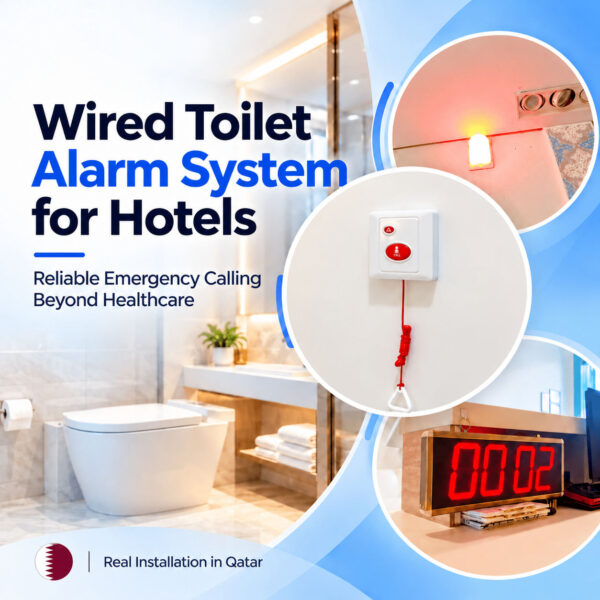
Real AIDBELL wired toilet alarm system installation in a hotel in Qatar, featuring an emergency call button, visual alarm indicator and digital call display.
Inside the bathroom, a guest can activate the emergency call using the installed call device and pull cord. Once the alarm is triggered, the system sends the call through the wired connection to the receiving equipment.
A digital display allows hotel staff to identify the relevant call location, while a visual alarm indicator provides an additional clear warning.
This type of configuration can be particularly useful in hotels with many guest rooms because staff need both an alarm and clear location information.
The installation also demonstrates an important point about emergency call technology:
The same communication principle used to help patients in hospitals can also help guests in hotels when emergency assistance is required.
Once an emergency call is activated, hotel staff need to know not only that assistance is required, but also where the call originated.
For larger hotel projects, clear location identification can significantly improve response efficiency.
This type of configuration provides both local alarm indication and centralized call identification, helping staff respond more efficiently when assistance is required.
The Qatar hotel installation gives contractors and system integrators a practical reference when considering similar bathroom emergency alarm projects.
More Than Hotels: Where Can Wired Toilet Alarm Systems Be Used?
Although this project was installed in a hotel, a toilet emergency alarm system can be used in many different environments.
Hospitals and clinics remain important applications, especially for patient toilets and accessible bathrooms.
Nursing homes and assisted-living facilities may require emergency assistance systems for elderly residents.
Hotels and resorts can provide emergency calling in guest bathrooms or accessible toilets.
Similar systems can also be considered for airports, shopping centres, schools, office buildings, railway stations and other public facilities.
For accessible toilets in particular, the objective is the same regardless of the building type: a person who needs assistance must have an easy way to activate an alarm, and staff must be able to identify and respond to that call.
This is why terms such as wired disabled toilet alarm system, accessible toilet alarm system and toilet emergency alarm system often describe closely related applications.
The final system configuration, however, should always be based on the requirements of the individual project and applicable local accessibility or building regulations.
Wired vs. Wireless Toilet Alarm Systems
Both technologies have advantages.
| Feature | Wired Toilet Alarm System | Wireless Toilet Alarm System |
|---|---|---|
| Communication | Fixed cable connection | Radio communication |
| Wireless coverage required | No | Yes |
| Cabling | Required | Usually minimal |
| Thick walls / multiple doors | Does not depend on RF penetration | Coverage should be checked |
| Battery at call points | Not normally required | Usually required |
| Retrofit projects | Cabling may be difficult | Often easier |
| New construction | Very suitable | Also possible |
| Expansion | Additional wiring may be needed | Often easier to add devices |
For a new hotel under construction, installing cables during the electrical and ELV works may make a wired system very practical.
For an existing hotel where opening walls or installing new cable is difficult, a properly designed wireless solution may be more convenient.
This is why AIDBELL provides both wired and wireless emergency calling solutions rather than applying the same technology to every project.
How to Plan a Wired Toilet Alarm System Project
Before selecting equipment, the supplier or system integrator should understand the building layout.
The number of bathrooms is important, but it is not the only consideration.
The project should also define:
- where alarms will be received;
- how staff will identify the calling location;
- whether visual and audible indicators are required;
- how cables can be routed between the toilets and the receiving point;
- whether the project requires one central display or multiple receiving points.
For larger projects, the room or toilet identification method becomes especially important.
A hotel with dozens of bathrooms needs more than a simple alarm buzzer. Staff should be able to quickly understand where assistance is required.
Providing a floor plan and the number of toilets therefore helps AIDBELL recommend a more appropriate system configuration.
A Practical Emergency Calling Solution Beyond Healthcare
AIDBELL has traditionally supplied nurse call systems for hospitals, clinics and elderly-care facilities.
However, emergency communication is needed wherever people may require assistance.
The Qatar hotel installation demonstrates how AIDBELL’s wired technology can extend beyond the traditional healthcare environment and provide a practical wired toilet alarm system for hotels and other commercial buildings.
For projects where wireless coverage may be challenging, or where permanent wired infrastructure is preferred, a wired emergency call system offers a simple and stable solution.
Beyond Healthcare. Reliable Emergency Communication Wherever Assistance Is Needed.
Planning a hotel, hospital, or public bathroom emergency alarm project?
Send AIDBELL your floor plan, number of toilets, and alarm receiving requirements, and our team can recommend a suitable wired or wireless solution.
Contact AIDBELL
Email: info@aidbell.com
Website: www.aidbell.com